

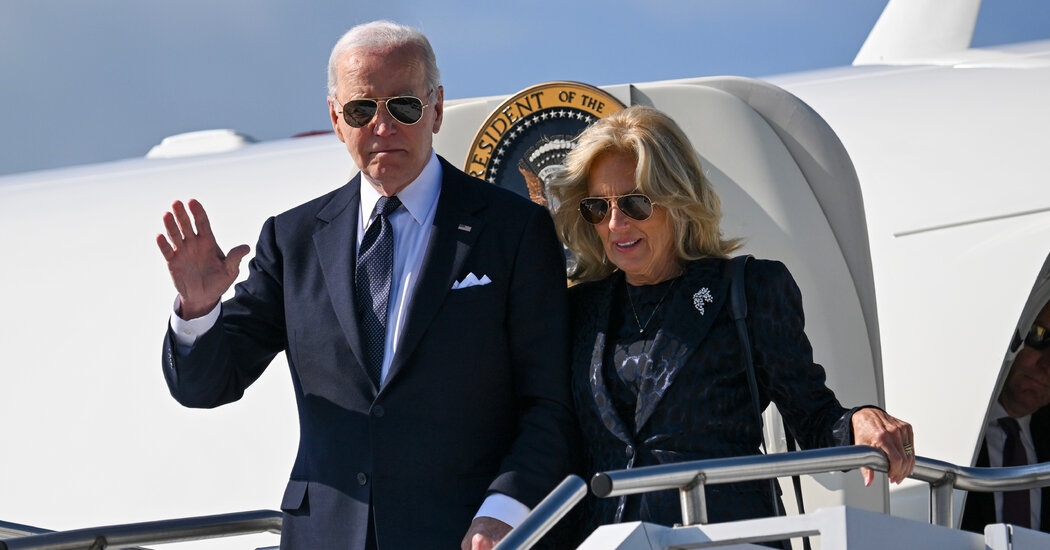
NORMANDY — President Biden will observe the 80th anniversary of D-Day on the beaches of Normandy on Thursday by asserting that the allied effort to stand up to Russia’s invasion of Ukraine is a direct extension of the battle for freedom that raged across Europe during World War II.
The president arrived for the ceremony and greeted surviving veterans shortly before his scheduled speech just steps from where 9,388 members of the American military are buried, most of whom participated in the Allied invasion at Omaha Beach. Their graves are marked with rows of stark white marble crosses or Stars of David, which gleamed under the bright sunlight and blue skies.
Mr. Biden, 81, who was a toddler when American and other Allied troops stormed the beaches here on June 6, 1944, will almost certainly be the last U.S. president to speak at a Normandy remembrance who was alive at the time Allied forces began to push Adolf Hitler out of Europe.
Now, eight decades later, Mr. Biden is leading a coalition of European and other nations in a very different war on the continent, but for a very similar principle — pushing back against the attempted seizure of a neighboring country, in this case Ukraine, by President Vladimir V. Putin of Russia.
In remarks at the Normandy American Cemetery, the president will draw a direct line between the two, connected by the defense of a rules-based international order.
“Today, in 2024, 80 years later, we see dictators once again attempting to challenge the order, attempting to march in Europe,” said Jake Sullivan, the president’s national security adviser. He told reporters that Mr. Biden would make the case that “freedom-loving nations need to rally to stand against that as we have.”
Mr. Biden’s appearance at the cemetery was the first public event of a five-day visit to France, which will include a second speech on Friday at Pointe du Hoc and a state dinner hosted by President Emmanuel Macron of France in Paris on Saturday. Mr. Biden will return to Europe a few days later for a meeting of the leaders of the Group of 7 nations in Italy.
Before Mr. Biden’s address, the audience delivered a nearly hourlong series of standing ovations as a procession of D-Day veterans arrived. Most of the men, now in their late 90s or over 100 years old, were rolled up a blue-carpeted ramp in wheelchairs. A few managed to walk with canes or even unassisted, drawing extra applause.
With medals on their chests, baseball caps identifying their service on their heads and in a few instances tears in their eyes, the veterans saluted, waved, took selfies and flashed thumbs-ups. One took pictures with a windup disposable camera. A few women were among them as well.
Among those in the audience were Tom Hanks, the actor, and Steven Spielberg, the director, who made the film “Saving Private Ryan” and have dedicated themselves to documenting the lives and service of the World War II generation. Other guests included senators, members of Congress and relatives of those who fought in the conflict.
Mr. Biden met with veterans before his speech in a small glass-backed gazebo overlooking Omaha Beach, leaning down to shake the hands of those in wheelchairs and offering them command coins that he had made up specially for this 80th anniversary commemoration.
“The greatest generation ever, man,” he told one 102-year-old veteran.
“You saved the world,” he told another.
Some of the veterans told Mr. Biden they were honored to meet him. One had advice for the president: “Don’t get old,” the veteran said, as he settled back in his wheelchair.
After his remarks, Mr. Biden is scheduled to join Mr. Macron and others at Omaha Beach, site of some of the heaviest, deadliest fighting between U.S. forces and the German occupiers in France.
American officials said the somber backdrop of Normandy — where the allies helped turn the tide after nearly five years of war — is meant to underscore the stakes for Europe and the world if the United States and its fellow nations lose their resolve and let Mr. Putin win.
Mr. Biden has said that the months of congressional refusal to approve funding for Ukraine set back the war effort there, giving Russian forces the opportunity to push forward along battle lines in the north and east of the country.
Mr. Sullivan said that the president would deliver a speech “that will talk about, against the backdrop of war in Europe today, the sacrifices that those heroes and those veterans made 80 years ago and how it’s our obligation to continue their mission to fight for freedom.”
On Friday, Mr. Biden will return to the beaches of Normandy to deliver a second speech, this time at Pointe du Hoc, where Army Rangers scaled huge cliffs in an effort to secure critical military positions held by the Germans.
Officials said that the president would use that backdrop to make a broader point about the dangers of isolationism and the need to protect and nurture democracy. John F. Kirby, a retired Navy admiral and the White House national security spokesman, said the speech would be different from previous addresses by Mr. Biden on the topic of protecting democracy.
“You can point to real lives that were impacted at Pointe du Hoc,” he said. “You can point to real blood that was spilled in pursuit of that loftier goal. And you can tell stories about real men who climbed real cliffs and faced real bullets and real danger in the pursuit of something a whole hell of a lot bigger than themselves.”

